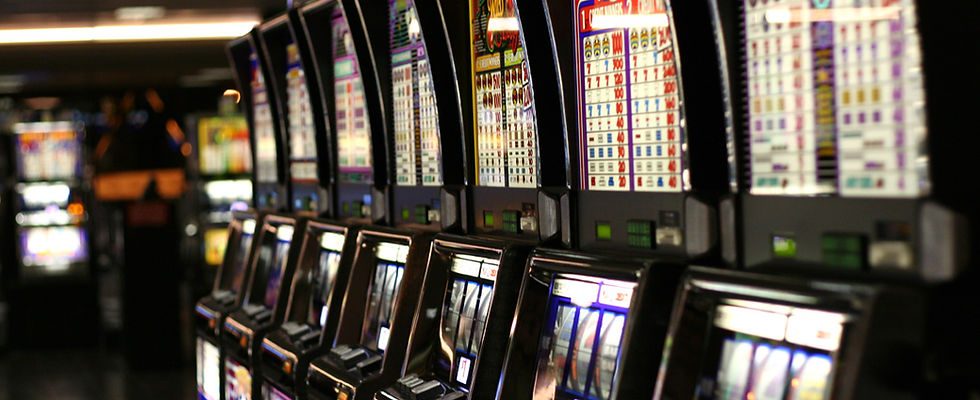
For centuries, the allure of chance has captivated humanity. But nothing has fueled the gambling explosion quite like this device.
From humble beginnings, a simple invention ignited a global phenomenon. The slot machine. Once a novelty, it quickly transformed into a multi-billion dollar invention, reshaping the landscape of entertainment and gambling.
It’s addictive, perfectly crafted, orchestrated to keep players hooked,and impossible to predict. or is it ?
What makes it the most played game on casino floors.. Why is it a money printing machine, literally. And how does it actually work ?
We modeled the entire thing to show you exactly that.
This is a look inside the inner workings of the slot machine.
BODY
HUMBLE BEGINNINGS
Before we jump into what the slot machine has become today, we must go back in time.The year was 1895, and in Brooklyn, New York, a mechanic named Charles Fey created the world's first slot machine, the Liberty Bell. Unlike modern slots, the Liberty Bell was a purely mechanical device.
It featured three spinning reels with five symbols each: horseshoes, diamonds, spades, hearts, and a Liberty Bell. Players inserted a nickel and pulled a lever, spinning the reels in the hope of lining up matching symbols.
A winning combination would dispense payouts, initially in the form of chewing gum or cigars, later evolving to coins. The Liberty Bell's simple yet captivating gameplay quickly made it a sensation, spreading rapidly across saloons and other establishments. Its success paved the way for the development of more advanced slot machines, laying the foundation for the multi-billion dollar gambling industry we know today. But the slot machine has changed tremendously for the better or worse. Depends on which side you’re on.
THE RISE OF ONE-ARMED BANDIT
Initially confined to saloons and arcades, its addictive gameplay and promise of quick riches fueled its rapid spread. The electromechanical era saw significant advancements, with more reels, symbols, and complex payout structures, further enhancing its allure. Casinos quickly recognized the slot machine's potential, strategically placing them throughout their establishments. What changed the gambling scene even further was the repeal of Prohibition in 1933.
The legalization of gambling in Nevada further fueled the growth of casinos, and slot machines became increasingly prominent fixtures. The post-World War II era witnessed a significant boom in Las Vegas tourism, and slot machines' simple gameplay and widespread appeal made them popular attractions for tourists.
But we get all that.. Tourist numbers grew, new flashy casinos emerged in a growing economy and a stronger spending power for the average american. But something is still missing. How exactly did slot machines take over the way they did ? This is when deep intentional design tactics come into play.
CASINOS DESIGN
What keeps gamblers glued to casino machines and tables is a pure reflection of human behavior.
Casinos use every trick in the book so that they make sure that the house always wins.
From the general design of the facility to the most intricate details, everything is calculated. Funny enough, Casinos don’t rely on luck.
You see whenever someone does hit that rare big win on a machine, bright lights flash and sound blare, and when someone rakes in the cash on the tables, cheers arise.
These celebrations create a false sense of possibility that keeps other players bleeding chips, even though someone else's win does nothing to increase the chances you'll do the same. If a player starts thinking: if I stay long enough, I might get lucky. That’s usually when things start to go south.
But lights and psychological tricks are just the surface. things get much deeper than that.
In the nineties, There was a dominant casino design style.
The Friedman design.
Bill Friedman is a recovering gambling addict who used his experience to shape many of today’s casinos. He intended to figure out how to keep players staying inside the casinos for as long as possible.
He innovated what’s called the grocery store design. He came up with 13 design principles.
The most important ones to note are the following.
According to Friedman, Casinos should be designed in a maze-like layout. This design pushes for chaos and higher information rates.
Machines and tables are placed almost in an arbitrary way, with narrow passages in between, making the games the center of attention.
low ceilings, and in most cases no windows. Friedman wants you to start gambling as soon as you step inside the casino. No space should be wasted, and gambling activity should be available straight away. With big, hotel-style lobbies the player is greeted by vast emptiness, which he argues creates a barn feel, rather than that of a casino. With slot machines as the most dominant game in the casino, for a reason.
How does the slot machine work ? and what makes it the casino’s favourite game ?
—--------
How Slot Machines Work
There’s much speculation on how slot machines work. Some say they’re rigged. Others say it’s pure luck while some say it sits somewhere in between.
After the player presses spin or pulls the handle, the Reel spins for 5 to 6 seconds and then stops to show the result.
On many slot machines the player can stop the Reel spins by pressing a certain button or by touching the screen.
For example, sometimes the player can press the spin button twice; the first press starts the reels spinning while the second press stops the reels quickly.
Inside every slot machine is a computer that determines the result for each play.
Each outcome is randomly selected and the computer is used for this purpose to do this.
It uses a random number generator that continually creates thousands of random numbers per second, even when the slot machine is not being played.
The instant a player pulls the handle or presses the spin button, the random numbers available at that moment are picked.
Each is used to determine the stopping position of one of the reels on the slot machine. This means that the computer instantly knows the outcome and where each reel will stop regardless of how long the reels spin.
The computer then spins the reels and eventually stops them at the already determined positions. In other words how long the Reel spin has no effect on the result. Each and every pull on a slot machine is a completely separate mathematical event. It is not influenced in any way by what’s happened up to that point.
Let’s say you spend 3 hours on a slot machine with no luck. You decide to take a break for 15. Next person sits at the same machine right after you and wins on the first try. In this situation you may think, it should’ve been you because you warmed it up with losses up to that point. Well that couldn’t be far from reality.
You would’ve needed to press the button at the same exact millisecond as the next person who sat after you.
Depending on the type of slot machine, The computer picks a number. That number is linked to a reel. For example, In the game of Double Diamond, which is a three real machine, it will pick a number between 1 and 72. Here’s a table that shows you how the number generator actually works. On the left column, you see the number picked by the generator, on the right column it shows what the reel is supposed to show on the payline. No matter how many reels the game has, the concept remains the same. But probability may differ.
Which takes us to a really important question. What are your chances ?
Let's examine the probability distribution of outcomes on a Double Diamond slot machine. A chart reveals that a spin results in no win (the casino retains the money) with an 85.7% probability.
A single cherry outcome has an approximate 5% chance (18,960 possibilities out of the total possibilities).
However, the probability of hitting the jackpot (three double diamonds) is exceptionally low: 0.002% or 8 out of 373,480 spins.
This illustrates that slot machine results are based on straightforward mathematical probabilities, not complex algorithms, similar to a roulette wheel. I’m not a math expert, but those are clearly not good enough odds to play against.
Slot machines are the real money-makers in Vegas casinos.
In 2024, Nevada casinos made a record-breaking $15.6 billion, and a huge chunk of that, about $10.5 billion (that's almost 67%!), came from slots.
On the Vegas Strip, it's even more insane, with slots making up over 70% of all the casino cash.
Think about this: a single slot machine can bring in $200 to $300 every day! With a casino having hundreds or even thousands of machines, that's a whole lot of money rolling in.
And it's not slowing down either, slot machine revenue hit $35.51 billion in 2023, a 3.8% jump from the year before.
The slot machine is designed to keep players hooked, even if they're losing. So while those slot machines are making casinos rich, a lot of players are losing money, sometimes a lot of money.
Professional gamblers often say that you must establish a strict budget and stick to it. Choose machines with higher RTP (Return to Player) percentages, ideally above 96%, and play within your means by using lower bet amounts.
Take regular breaks to avoid impulsive decisions and losing track of your spending.
Avoid playing multiple machines simultaneously, and most importantly, know when to walk away. But no matter how smart you play. the house always wins.